
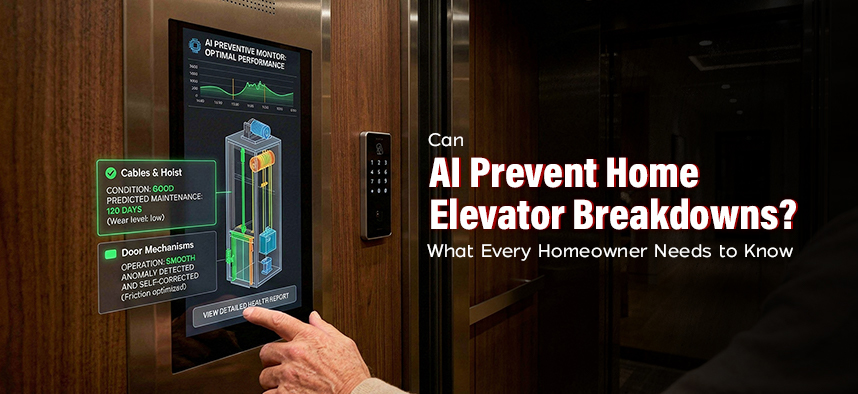
Can AI Prevent Home Elevator Breakdowns? What Every Homeowner Needs to Know
Table of Contents
- Introduction
- Why Do Home Elevators Break Down?
- What Is AI-Powered Elevator Maintenance?
- How AI Helps Prevent Home Elevator Breakdowns
- Traditional Maintenance vs AI-Powered Maintenance
- The Role of Smart Technology in Modern Home Elevators
- Real-World Scenario: How AI Can Prevent a Breakdown
- Key Benefits of AI-Powered Home Elevators
- Can AI Completely Eliminate Elevator Breakdowns?
- The Future of Residential Elevators
- FAQs
- Conclusion
Introduction
A home elevator is one of the most valuable additions to a modern residence. It improves accessibility, enhances convenience, and adds long-term value to your property. However, like any sophisticated mechanical system, elevators require consistent monitoring and maintenance to ensure smooth operation.
Traditionally, elevator maintenance has been reactive. A problem appears, performance declines, and only then is a technician called.
Today, Artificial Intelligence (AI) is changing that approach.
Modern home elevators are becoming smarter through AI-powered monitoring, predictive maintenance, IoT connectivity, and real-time diagnostics. These technologies can identify warning signs early, helping prevent costly breakdowns before they occur.
But can AI completely prevent elevator failures?
Let's explore what every homeowner should know.
What if your elevator could spot issues before they become breakdowns?
Explore Smart Home ElevatorsWhy Do Home Elevators Break Down?
Even premium residential elevators experience wear over time. Common causes of elevator downtime include:
- Motor wear and tear
- Door alignment issues
- Sensor malfunctions
- Electrical faults
- Brake system irregularities
- Power fluctuations
- Poor maintenance practices
- Aging mechanical components
Most of these issues do not occur suddenly. They develop gradually, often showing subtle warning signs long before a complete failure occurs. The challenge is that these signs are often invisible to homeowners and may even go unnoticed during routine inspections.
This is where AI-driven elevator technology creates a significant advantage.
What Is AI-Powered Elevator Maintenance?
AI-powered maintenance uses smart sensors, connected monitoring systems, and machine learning algorithms to continuously track elevator performance.
Instead of relying solely on scheduled maintenance visits, the system monitors:
- Motor performance
- Door operation cycles
- Travel speed consistency
- Ride comfort
- Temperature variations
- Energy consumption
- Component wear patterns
- Usage frequency
The data is analyzed continuously to identify unusual patterns that may indicate an upcoming issue. This approach is known as predictive maintenance, and it is becoming one of the most important innovations in modern residential elevators.
Ready for a home elevator that's as smart as the rest of your home?
Discover Intelligent ElevatorsHow AI Helps Prevent Home Elevator Breakdowns
1. Early Detection of Potential Problems
Many elevator issues begin as small performance changes.
For example:
- Slightly higher motor vibration
- Delayed door closing
- Increased energy consumption
- Irregular sensor readings
While these changes may seem insignificant, they often indicate developing mechanical or electrical problems. AI systems can detect these abnormalities early and generate maintenance alerts before they become serious failures.
2. Predictive Maintenance Instead of Reactive Repairs
Traditional maintenance follows fixed schedules. However, elevator usage varies significantly from one home to another. A family using their elevator 30 times daily creates different wear patterns than a household using it only a few times a day.
AI analyzes real-world usage and predicts:
- Which components are experiencing increased wear
- When maintenance should be scheduled
- Which parts may require replacement soon
This results in more efficient servicing and fewer unexpected breakdowns.
Ready to transform the way you move through your home?
Start Your Elevator Journey3. Continuous Remote Monitoring
One of the biggest advantages of smart elevator systems is continuous monitoring. Advanced residential elevators can provide real-time operational insights through IoT-enabled technology and remote diagnostics. Features such as remote monitoring and smart control systems help identify issues before they affect performance.
Benefits include:
- Faster issue identification
- Reduced downtime
- Improved reliability
- Enhanced homeowner peace of mind
4. Faster Troubleshooting and Repairs
When a fault occurs, AI-generated performance reports help technicians quickly identify the likely source of the problem. Instead of manually inspecting multiple systems, maintenance teams can focus on the affected component immediately.
This leads to:
- Faster repairs
- Reduced service interruptions
- Lower maintenance costs
- Improved elevator uptime
5. Enhanced Safety Monitoring
Safety remains the most important aspect of any home elevator.
AI-powered systems continuously monitor critical safety functions such as:
- Brake performance
- Door operation
- Motor temperature
- Travel consistency
- Sensor functionality
If abnormal behavior is detected, the system can alert maintenance teams before the issue affects passenger safety.
Want fewer maintenance surprises and more peace of mind?
Find Your Perfect Home ElevatorTraditional Maintenance vs AI-Powered Maintenance
| Feature | Traditional Maintenance | AI-Powered Maintenance |
|---|---|---|
| Fault Detection | After a problem occurs | Before a problem occurs |
| Monitoring | Periodic inspections | Continuous monitoring |
| Maintenance | Schedule | Fixed intervals, predictive, and usage-based |
| Downtime | Risk | Higher Lower |
| Troubleshooting | Manual diagnosis | Data-driven diagnostics |
| Repair Costs | Often higher | Often lower |
| Reliability | Good | Significantly improved |
The Role of Smart Technology in Modern Home Elevators
The latest generation of residential elevators is moving beyond basic vertical transportation.
Modern systems increasingly incorporate:
- IoT-based monitoring
- Remote diagnostics
- Smart control interfaces
- Energy-efficient drive systems
- Predictive maintenance capabilities
Epic Elevators' Bellissimmo home elevator, for example, incorporates remote monitoring capabilities, smart safety systems, energy-efficient technology, and intelligent control features designed to improve reliability and user experience.
Similarly, Epic's EPICube platform leverages IoT-based technology to simplify lift monitoring and maintenance management, making elevator performance tracking more proactive and efficient.
Could your home benefit from next-generation elevator technology?
See Smart Elevator FeaturesReal-World Scenario: How AI Can Prevent a Breakdown
Imagine a home elevator motor beginning to generate unusual vibration levels.
Without intelligent monitoring, the issue may continue unnoticed until:
- Ride quality deteriorates
- Components experience excessive wear
- The elevator eventually stops operating
An AI-enabled monitoring system identifies the abnormal vibration pattern immediately. The system generates an alert, allowing maintenance personnel to inspect the motor before a failure occurs.
The result?
- Minimal repair costs
- No unexpected downtime
- Improved safety
- Longer equipment lifespan
This is the practical value of predictive maintenance.
Key Benefits of AI-Powered Home Elevators
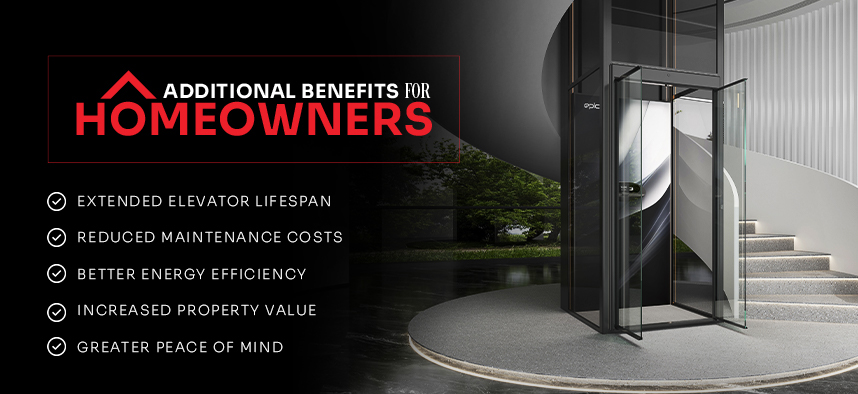
The advantages of intelligent elevator technology extend far beyond maintenance, creating a smarter and more reliable living experience.
Can AI Completely Eliminate Elevator Breakdowns?
No.
While AI significantly reduces the likelihood of failures, it cannot eliminate every possible issue.
Unexpected situations such as:
- Power surges
- Physical damage
- Natural disasters
- Manufacturing defects
can still cause elevator problems.
However, AI dramatically lowers the risk of breakdowns caused by gradual wear, maintenance oversight, or hidden component issues.
For more details, check out Why Manufacturing Transparency Is Becoming a Key Decision Factor for Builders.
The Future of Residential Elevators
The future of home elevators is becoming increasingly intelligent.
Industry trends point toward:
- Self-diagnostic systems
- Automated maintenance scheduling
- Advanced remote monitoring
- Real-time mobile alerts
- Enhanced energy optimization
- Smarter safety technologies
As homeowners increasingly seek convenience, accessibility, and reliability, AI-powered elevators will become a standard feature in premium residential properties.
Looking for the right home elevator for your space and needs?
Book a Free ConsultationFrequently Asked Questions
1. Can AI completely prevent elevator failures?
No. AI reduces the risk of breakdowns by identifying potential issues early, but unforeseen events can still cause failures.
2. What is predictive maintenance in home elevators?
Predictive maintenance uses AI and smart sensors to monitor elevator performance and identify issues before they result in downtime.
3. Are smart home elevators worth the investment?
For homeowners seeking long-term reliability, lower maintenance costs, and enhanced safety, smart elevator technology can provide substantial value.
4. Does remote monitoring improve elevator reliability?
Yes. Remote monitoring enables continuous performance tracking and faster response to developing issues.
5. How often should a home elevator be serviced?
Professional maintenance should still be performed according to the manufacturer's recommendations, even when AI monitoring is available.
Conclusion
Artificial Intelligence is transforming the way home elevators are maintained. By combining predictive maintenance, smart sensors, remote monitoring, and real-time diagnostics, AI helps identify problems before they become costly breakdowns. While no technology can guarantee a completely failure-free elevator, AI significantly improves reliability, safety, and performance.
For homeowners investing in modern residential elevators, intelligent monitoring is no longer just an advanced feature; it is becoming an essential part of ensuring a safer, smarter, and more dependable vertical mobility experience.

