

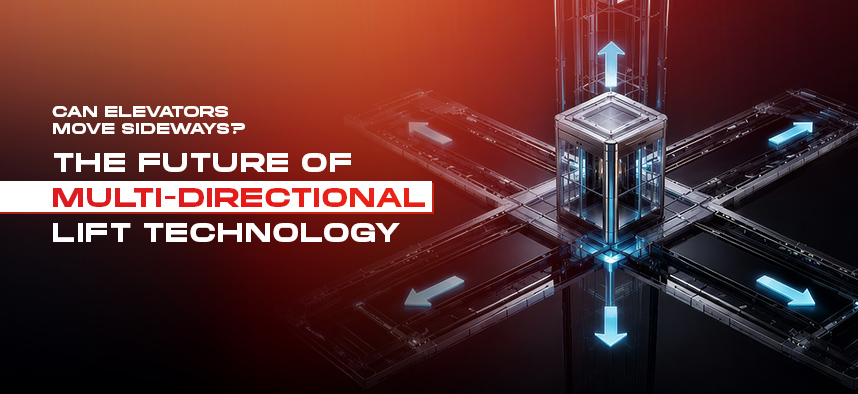
Can Elevators Move Sideways? The Future of Multi-Directional Lift Technology
Table of Contents
Introduction
When you think of an elevator, you probably imagine it moving straight up or down. But what if your elevator could also move sideways, connect multiple towers, or intelligently choose the fastest route to your destination?
It may sound like science fiction, but it's quickly becoming a reality. As cities grow taller and buildings become more complex, the future of elevators is moving beyond traditional cable systems. Innovations like magnetic levitation (maglev), artificial intelligence (AI), regenerative drives, and predictive maintenance are redefining how people move within buildings.
Let's explore the technologies shaping the next generation of elevators and what they mean for the future of urban mobility.
Bring the future of elevator technology to your next project.
Talk to Our ExpertsTraditional Elevators vs. Multi-Directional Elevators
| Traditional Elevators | Multi-Directional Elevators |
|---|---|
| Move only vertically | Move vertically and horizontally |
| Operate using steel ropes and counterweights | Use linear motors and magnetic propulsion |
| One elevator cabin per shaft | Multiple cabins can operate within the same system |
| Limited by rope length | Suitable for taller, more complex buildings |
| Higher waiting times during peak hours | AI optimizes passenger flow and reduces wait times |
1. Ropeless Maglev Systems
One of the most exciting innovations in elevator technology is the ropeless elevator. Instead of steel ropes, these systems use linear motors and magnetic levitation (maglev) technology to move elevator cabins.
Similar to how maglev trains operate, electromagnetic forces propel the cabin smoothly through specially designed shafts. Unlike traditional elevators, these systems can move both vertically and horizontally, allowing cabins to travel between connected buildings or different sections of a high-rise.
This breakthrough offers architects greater design flexibility while increasing transportation capacity without adding extra elevator shafts.
Build smarter with next-generation elevator solutions.
Get a Free Consultation2. AI Destination Dispatch
Artificial Intelligence is making elevators more efficient than ever.
With AI destination dispatch, passengers enter their destination floor before boarding. The system then groups people travelling to similar floors into the same elevator, minimizing unnecessary stops and reducing waiting times. AI continuously analyzes passenger traffic, peak usage hours, and building occupancy to optimize elevator movement in real time.
Benefits include:
- Shorter waiting times.
- Faster travel.
- Reduced energy consumption.
- Improved passenger experience.
- Better handling of peak-hour traffic.
As smart buildings become more common, AI-powered elevators will continue learning and improving their performance over time.
3. Regenerative Drives
Modern elevators aren't just becoming smarter, they're becoming more energy-efficient too.
Regenerative drive technology captures excess energy generated during elevator movement. For example, when a heavily loaded elevator travels downward, it produces energy that would normally be lost as heat. Instead, regenerative systems convert this energy into electricity and feed it back into the building's power supply.
This helps:
- Reduce electricity consumption.
- Lower operating costs.
- Improve energy efficiency.
- Support sustainable building practices.
For commercial buildings with frequent elevator usage, regenerative drives can significantly reduce long-term energy expenses.
Future-ready buildings deserve smarter elevators.
Explore Our Solutions4. Predictive Self-Diagnostics
Imagine receiving a maintenance alert before an elevator ever stops working.
That's exactly what predictive diagnostics can do.
Using IoT sensors, elevators continuously monitor important components such as motors, brakes, doors, vibration levels, and temperature. AI analyzes this data to detect early signs of wear and notify maintenance teams before a fault occurs.
This proactive approach results in:
- Improved passenger safety.
- Reduced downtime.
- Lower maintenance costs.
- Longer equipment life.
- Greater operational reliability.
It's a smarter way to keep elevators running efficiently while minimizing unexpected service interruptions.
How Indian Elevator Manufacturers Are Adapting
Although fully multi-directional elevators are still an emerging technology, many of the innovations behind them are already influencing modern lift systems. Today, leading elevator manufacturers are integrating features such as IoT-enabled remote monitoring, regenerative drives, gearless technology, destination control systems, and advanced safety mechanisms into their products.
For builders, architects, and businesses looking for reliable vertical transportation, choosing experienced elevator manufacturers in Gujarat means investing in technology that is energy-efficient, intelligent, and future-ready. Many lift manufacturers in Gujarat are continuously upgrading their engineering capabilities to meet the growing demand for smart buildings, strengthening their reputation among the top 10 elevator companies in Gujarat. Whether you're planning a residential, commercial, or industrial project, partnering with a trusted elevator company in Gujarat ensures your building is equipped with solutions designed for the future.
Upgrade your building with intelligent elevator technology.
Connect with Our TeamFrequently Asked Questions
1. Can elevators really move sideways?
Yes. Multi-directional elevators use linear motors and magnetic levitation technology instead of traditional steel ropes, allowing them to move both vertically and horizontally within specially designed building systems.
2. Are sideways elevators available in India?
Sideways-moving elevators are not yet widely available in India. However, many modern elevators already incorporate advanced technologies such as AI destination control, regenerative drives, and IoT monitoring that are paving the way for future innovations.
3. What are the benefits of AI-powered elevators?
AI-powered elevators reduce waiting times, improve passenger flow, optimize energy consumption, and efficiently manage peak-hour traffic by intelligently grouping passengers travelling to similar floors.
4. How do regenerative elevators save energy?
Regenerative elevators capture excess energy produced during operation and convert it into electricity that can be reused within the building, helping reduce energy consumption and operating costs.
5. How are elevator manufacturers in Gujarat preparing for the future?
Leading elevator manufacturers in Gujarat are investing in smart technologies such as IoT-enabled monitoring, energy-efficient drives, advanced safety systems, and predictive maintenance to deliver reliable, future-ready elevator solutions for residential, commercial, and industrial projects.
The Future Is More Than Vertical
The next generation of elevators won't simply take people from one floor to another. They will communicate with buildings, optimize passenger traffic using AI, generate energy, monitor their own performance, and eventually move in multiple directions.
While sideways-moving elevators are still in the early stages of commercial adoption, the technologies supporting them are already transforming the elevator industry. As cities become smarter and buildings grow taller, intelligent elevators will play a key role in creating safer, more efficient, and more sustainable urban spaces.

