

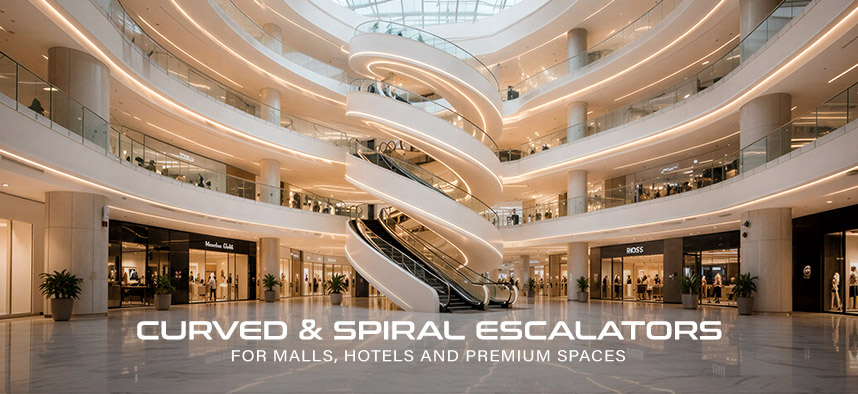
Curved and Spiral Escalators for Malls, Hotels and Premium Spaces
Table of Contents
- Introduction
- When the Journey Between Floors Becomes Part of the Experience
- The Rare Appeal of True Spiral Escalators
- Why Premium Malls Are Drawn to Curved and Spiral Escalator Designs
- Landmark Spaces Need More Than Standard Solutions
- The Passenger Experience Is More Than Travel Time
- Why Curved and Spiral Escalators Remain Aspirational
- Choosing the Right Escalator for a Premium Space
- A Different Direction for Premium Vertical Transportation
Introduction
In premium architecture, the most memorable spaces are rarely defined by one feature alone. The atrium, lighting, materials, retail frontage, and movement of people all contribute to how a building feels. Even vertical transportation can become part of that experience. Curved escalators and true spiral escalators bring a different visual language to malls, hotels, and landmark spaces. Instead of simply connecting one floor to another, their form can shape sightlines, frame an atrium, and turn the journey through the building into part of the architecture.
For architects, developers and elevator manufacturers, these architectural escalators sit at the intersection of mobility, spatial planning and design expression. That makes them especially relevant to premium commercial projects where every visible element is expected to contribute to the overall design.
Make every floor transition part of the experience.
Explore Our Escalator SolutionsWhen the Journey Between Floors Becomes Part of the Experience
A conventional straight escalator is often designed to fit efficiently into a circulation plan. A curved escalator can be more visually expressive. Its sweeping path naturally attracts attention and creates a stronger relationship between different levels of a building. In a premium mall, this can make vertical movement feel connected to the overall retail experience. In a hotel, a curved escalator positioned near a lobby or event area can become part of the first visual impression. In a landmark development, it can contribute to the identity of the space itself.
This is where the role of lift manufacturers and vertical transportation specialists extends beyond supplying a standard product. The challenge is to understand how movement will interact with the architecture around it, while still meeting the practical requirements of a busy commercial building.
Curved Escalators and the Architecture of Space
Curved escalators are particularly suited to spaces where straight lines are not the only organising principle. Circular atriums, sweeping interiors, open retail courts and dramatic public areas can all benefit from a circulation element that follows the architectural character of the building.

A Visual Centrepiece Without Being a Separate Attraction
The strongest architectural features often feel integrated rather than added later. A well-positioned curved escalator can visually connect floors while complementing surrounding finishes, lighting and open space. Glass balustrades, carefully planned illumination and premium interior detailing can further strengthen this effect. The escalator becomes noticeable, but it still belongs to the building rather than competing with it.
For premium developments, this distinction matters. Visitors may not remember every functional element they encounter, but they often remember how a space made them feel.
Shaping Sightlines and Movement
Escalator placement influences more than passenger flow. It can affect what visitors see when they arrive on a floor, how easily they understand the building layout, and which areas naturally draw attention. Curved configurations can support a more fluid visual connection around an atrium or open central zone. This is particularly valuable in multi-level malls and mixed-use developments, where circulation needs to encourage movement while keeping the overall space visually connected.
When planning such environments, elevator companies in India and project consultants may be involved alongside architects and developers in coordinating the broader vertical transportation strategy, including lifts, escalators and other passenger movement systems. For a project in India, this early coordination can help ensure that the escalator concept fits the building's circulation, structure, and intended passenger experience.
Why settle for ordinary movement in an extraordinary space?
Find the Right Escalator SolutionThe Rare Appeal of True Spiral Escalators
Curved escalators and true spiral escalators should not be treated as exactly the same thing.
The term spiral escalator is sometimes used loosely for visually curved escalator designs. A true spiral escalator, however, follows a continuously curved route and is a highly specialised engineering solution. Mitsubishi Electric identifies itself as the only manufacturer of commercial spiral escalators, illustrating just how specialised this category remains worldwide.
That rarity adds to their aspirational appeal.
In the right setting, a true spiral escalator can become an architectural signature. Its value is not simply in moving passengers between levels, but in creating a sense of continuity and spectacle within the space. At The Forum Shops at Caesars Palace in Las Vegas, Mitsubishi Electric's spiral escalators were integrated into the interior as part of the destination's visual experience, demonstrating how specialised escalator design can support both circulation and architecture.
For developers exploring such specialised systems, working with experienced elevator manufacturers and appropriate technology partners becomes important because these projects require far more coordination than a standard escalator installation. It is also important to distinguish between a conventional curved escalator concept and a true spiral escalator, rather than treating every visually curved installation as the same technology.
Also, check out The Engineering Behind Space-Saving Home Elevators.
Why Premium Malls Are Drawn to Curved and Spiral Escalator Designs
Shopping malls have increasingly become destinations where architecture contributes directly to visitor engagement. Retail alone is not always enough to create a memorable experience. The building itself plays a role in encouraging people to explore, stay longer, and move between levels.
Curved escalators can contribute to this experience in several ways:
- They can create a stronger visual focal point within large atriums.
- They can make vertical movement feel more connected to the overall interior design.
- They can complement circular or free-flowing architectural layouts.
- They can improve the visual relationship between different floors.
The appeal is therefore not just about novelty. In the right architectural context, the form of the escalator can support how visitors experience the entire mall.
This is also why conversations around premium mobility solutions are becoming broader. Elevator manufacturers in India are part of projects where developers look beyond basic floor-to-floor movement and consider the complete passenger experience across a property. For brands such as Epic Elevators, whose range includes escalators alongside passenger, bungalow, hospital, scenic, and goods elevators, this broader approach reflects how modern buildings increasingly plan vertical transportation as a connected system.
When movement becomes part of the design.
Explore Our SolutionsLandmark Spaces Need More Than Standard Solutions
Airports, cultural destinations, major commercial developments, and other landmark spaces often face a different design challenge. They must handle significant passenger movement while maintaining a strong architectural identity. In these projects, transportation systems are highly visible. They cannot always disappear into the background.
A curved escalator can become part of the visual language of the building, particularly when placed in a large public atrium or central circulation zone. A true spiral escalator can take this even further, becoming a feature visitors associate with the destination itself. However, specialised architecture also requires realistic planning. Not every curved concept is suitable for every building, and not every project requires a true spiral escalator. The choice depends on the available space, building design, traffic requirements, and the level of architectural impact the project aims to achieve.
This is where experienced elevator manufacturing companies in India can support developers with broader vertical transportation planning while coordinating specialised solutions where required. The objective is not to make every project visually dramatic, but to select a solution that fits the building's architecture, traffic pattern, and long-term operational needs.
The Passenger Experience Is More Than Travel Time
Premium spaces are increasingly designed around the complete visitor journey. The view from an escalator, the changing perspective as a person moves through an atrium, and the visual connection between levels all influence how a building is perceived. A curved escalator can make that transition feel more intentional and immersive, while a true spiral escalator creates an even more distinctive visual journey through the surrounding space.
This is particularly relevant in experiential retail, hospitality and entertainment-led developments. The movement between floors does not have to feel like an interruption. It can become part of the experience.
At the same time, aesthetics cannot replace practical considerations. Passenger comfort, safety, traffic planning, accessibility, and long-term service requirements remain central to any vertical transportation decision. The best designs bring these considerations together rather than treating visual impact as a separate objective.
Make people look up before they move up.
Explore What’s PossibleWhy Curved and Spiral Escalators Remain Aspirational
Part of the appeal of these systems comes from the fact that they are not seen everywhere. Standard escalators are widely used because they provide an efficient and familiar solution for moving large numbers of people between floors. Curved escalators, and especially true spiral escalators, are more specialised architectural choices.
Their implementation can involve greater design coordination and specialised engineering. True spiral escalators are an especially rare category, available from very few manufacturers worldwide.
As a result, they are often associated with projects where the architecture itself is intended to stand out.
For elevator manufacturers, lift manufacturers and developers, the opportunity lies in recognising when a specialised design genuinely adds value to a project. A curve should not be introduced simply because it looks different. It should contribute to the way people move, see, and experience the building.
Choosing the Right Escalator for a Premium Space
The most effective solution is not always the most dramatic one. A conventional escalator may be the right choice for a high-traffic environment focused primarily on efficient movement. A curved escalator may suit a project where architectural form and passenger experience are equally important. A true spiral escalator is a far more specialised option, typically considered for projects seeking a highly distinctive architectural statement.
For developers, the decision should begin with the building rather than the product. The circulation pattern, available space, expected passenger traffic, architectural intent, and long-term maintenance requirements should all shape the vertical transportation strategy.
This is where elevator manufacturing companies in India, architects and vertical transportation consultants can work together to evaluate the broader mobility requirements of the project while identifying where specialised escalator solutions may add genuine design value. Epic Elevators approaches vertical transportation through consultation, design, manufacturing, installation, and ongoing maintenance, making early project coordination an important part of the process.
A Different Direction for Premium Vertical Transportation
As malls, hotels and landmark developments become more experience-focused, functional systems are increasingly expected to work alongside the architecture rather than sit apart from it.
Curved and spiral escalators represent that shift. They show how a system designed for passenger movement can also influence the identity of a space.
For developers working with elevator manufacturers in India or evaluating specialised global technologies, the conversation is no longer only about moving people efficiently between floors. It is also about how that movement fits into the larger architectural story. Epic Elevators already positions escalators within its wider range of vertical transportation solutions, making the subject relevant to the company's commercial and architectural audience without turning the article into a product pitch.
Because in premium spaces, even the journey between two floors can leave a lasting impression.

