

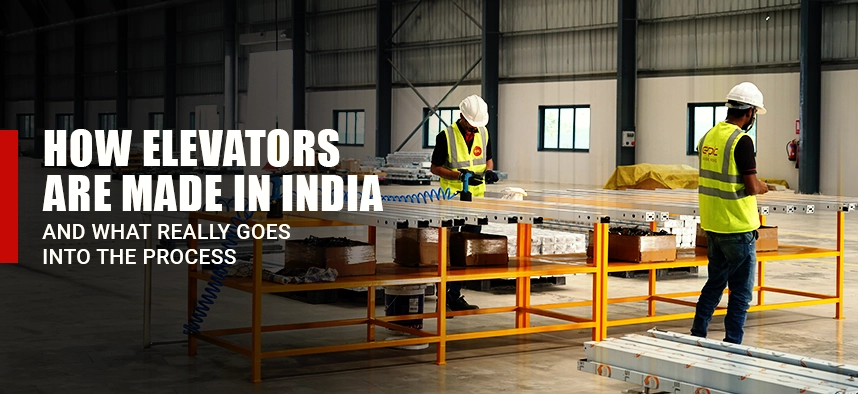
How Elevators Are Made in India and What Really Goes Into the Process
Table of Contents
- Introduction
- It Begins with Building-Specific Engineering
- Component Manufacturing Happens in Specialized Segments
- Safety Systems Are Built in Multiple Layers
- On-Site Installation
- Testing
- India’s Shift Toward Smart Elevator Technology
- Real Growth Drivers in India’s Elevator Industry
- The Future
- Final Thoughts
Introduction
India installs over 50,000-60,000 new elevators every year, and the number is growing rapidly with urbanization, metro rail expansion, and high-rise residential demand. Behind every smooth lift ride in a Mumbai skyscraper or a Delhi metro station is a complex manufacturing ecosystem driven by elevator manufacturers in India and highly engineered supply chains.
But how are elevators actually built in India? Let’s break it down beyond the basics.
1. It Begins with Building-Specific Engineering
Unlike mass-produced equipment, every elevator is custom-designed for the building it serves.
At the initial stage, elevator engineering teams evaluate:
- Shaft dimensions (which often vary even within the same project).
- Total travel height (low-rise vs high-rise behavior differs significantly).
- Passenger load requirements.
- Power backup availability in the building.
- Usage type: residential, hospital, commercial, or industrial.
For example, in metro cities like Mumbai or Ahmedabad, space constraints often lead elevator companies in India to deploy machine-room-less (MRL) systems, which eliminate the need for a separate machine room and optimize building space.
At this stage, clarity around materials, component sourcing, and system design becomes critical, which is why many developers today prioritize partners who offer complete visibility into their processes. You can explore this shift in detail in our blog on why manufacturing transparency is becoming a key decision factor for builders.
Maximize space efficiency with next-gen MRL elevator systems
Discover MRL Technology2. Component Manufacturing Happens in Specialized Segments
A common misconception is that elevators are built in a single facility, like automobiles. In reality, elevator manufacturing companies in India operate through a distributed production model.
Different components are manufactured separately:
- Cabin Structure.
- Stainless steel sheets (commonly SS 304 grade).
- Laser-cut panels for precision alignment.
- Anti-vibration flooring systems for ride comfort.
India has strong fabrication clusters in Gujarat, Maharashtra, and Tamil Nadu that supply these components.
Drive & Machine Systems
This is the core of the elevator.
Modern systems used by advanced elevator manufacturers in India include:
- Gearless traction machines (for high-rise efficiency).
- V3F drives for smooth acceleration/deceleration.
- Regenerative drives that recover braking energy and reduce power consumption by up to 20-30%.
This is a major shift from older geared systems used in low-rise buildings.
Control Systems
The intelligence layer includes:
- Microprocessor-based controllers.
- Digital floor selection logic.
- Safety interlocks and diagnostics systems.
Modern systems are increasingly IoT-enabled, allowing predictive maintenance and remote monitoring, a growing trend among leading elevator companies in India.
Reduce energy costs with advanced elevator engineering
Explore Energy-Efficient Lifts3. Safety Systems Are Built in Multiple Layers
Safety is not a single component; it is a multi-layer engineered system.
Every elevator includes:
- Overspeed governor (prevents uncontrolled descent).
- Electromagnetic brakes.
- Door interlock systems.
- Buffer springs at the shaft base.
In high-end installations such as hospitals or premium residential towers, additional safety logic is added for:
- Smooth start/stop control (to avoid jerk movement).
- Emergency evacuation behavior.
- Power failure auto-rescue systems.
Indian safety standards follow IS 14665, while many global manufacturers also align with European EN 81 norms. For more details, check out our latest blog on Core Elevator Safety Components That Support Safe and Smooth Operations
4. On-Site Installation
Unlike factory-assembled products, elevators are assembled directly inside the building shaft.
This includes:
Guide Rail Installation
Rails are fixed vertically using laser alignment tools. Even a millimeter-level deviation can impact ride quality.
- Machine Installation: Depending on the design, the traction machine is installed either at the top (overhead systems) or integrated within the shaft (MRL systems).
- Cabin Assembly: The cabin is constructed piece by piece inside the shaft using scaffolding systems.
- Electrical Integration: Modern elevators can include hundreds of meters of wiring connected to control panels, sensors, and safety systems.
This stage is highly technical and typically takes 2 to 6 weeks per elevator, depending on building height and complexity.
Design elevators that fit your building, not the other way around
Get a Custom Elevator Plan5. Testing
Before commissioning, every elevator undergoes strict testing protocols:
- Full load test (100% rated capacity).
- Overload test (125% capacity as per safety norms).
- Brake failure simulation.
- Emergency power failure testing.
- Continuous cycle testing.
For high-traffic buildings like malls or metro stations, elevators are often tested for extended operational cycles (up to 48-72 hours) before approval.
This ensures reliability in real-world high-usage conditions.
6. India’s Shift Toward Smart Elevator Technology
Modern elevator manufacturers in India are rapidly shifting toward intelligent systems.
Key advancements include:
- Energy-Efficient Systems: Regenerative drives convert braking energy into usable power, reducing electricity consumption.
- Smart Diagnostics: Sensors continuously monitor vibration, load, and door performance to predict maintenance needs before failures occur.
- Destination Control Systems: Instead of simple up/down buttons, users select destination floors, improving traffic flow efficiency in high-rise buildings.
- Space Optimization Technology: Innovations like compact machine-room-less systems (similar to Epic’s space-saving design philosophy) allow elevators to fit into tighter architectural constraints without compromising performance.
Make every square foot count with space-optimized elevators
Explore Bellisimmo7. Real Growth Drivers in India’s Elevator Industry
The expansion of elevator companies in India is driven by:
- Rapid urbanization and skyscraper development.
- Growth of smart cities and infrastructure projects.
- Expansion of metro rail networks (Delhi, Mumbai, Bangalore, Ahmedabad).
- Increasing demand for home elevators in villas and bungalows.
- Healthcare infrastructure expansion requires hospital-grade lifts.
India is now one of the fastest-growing elevator markets globally, with demand rising in both Tier 1 and Tier 2 cities.
8. The Future
The future of elevator manufacturing in India is shifting from mechanical transport to intelligent vertical mobility systems.
Companies like Epic Elevators are contributing to this evolution with innovations such as:
- MRL belt technology for space efficiency.
- Compact control systems for smarter operations.
- Custom-built elevator solutions for different building types.
- Energy-efficient and sustainable lift systems.
The goal is no longer just movement; it is smarter, safer, and more efficient vertical living.
Final Thoughts
Every elevator installed in India today is the result of a highly coordinated process involving engineering design, precision manufacturing, safety engineering, and on-site installation expertise. Modern elevator manufacturers in India are no longer just mechanical suppliers; they are technology-driven solution providers shaping the future of urban infrastructure. And as cities continue to grow vertically, elevators will remain one of the most critical systems powering that transformation.

