

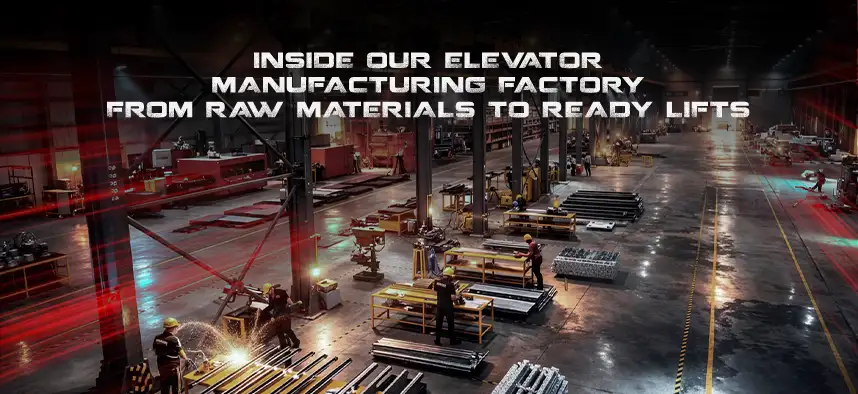
From Raw Materials to Ready-to-Install Lifts - How We Manage
An elevator is one of the few machines people trust every single day without giving it a thought. It opens, moves, stops, and carries weight repeatedly, often for decades. That kind of reliability doesn’t come from a single component or a single inspection. It comes from a process that is managed carefully from the very beginning.
At Epic, we approach manufacturing with the belief that consistency is not created at the end of production; it is built into every stage. This approach reflects the growing maturity of elevator manufacturing in India, where the focus has shifted from simply producing lifts to engineering systems that perform predictably over time. Across the country, buildings are becoming more complex, and expectations for vertical mobility are rising. In response, elevator manufacturers in India are adopting structured, process-driven methods that prioritize durability, precision, and installation readiness. The result is a more disciplined and transparent elevator manufacturing process in India, supported by a new generation of technically capable elevator companies in India.
Here is how we manage that journey.
Why Building Analysis Is Critical to Elevator Planning
Real manufacturing begins long before materials arrive at the factory. Every lift must match the environment in which it will operate, not just in size, but in behavior. The first stage of modern elevator manufacturing in India is therefore analytical. Engineers evaluate travel distance, expected load patterns, usage frequency, shaft configuration, and structural limitations. These inputs shape every technical decision that follows.
Experienced elevator companies in India treat this stage as foundational. When planning is precise, manufacturing becomes controlled. When planning is rushed, manufacturing becomes reactive. A structured start is what allows the elevator manufacturing process in India to move forward with clarity.
Bring Process-Driven Quality to Your Project
Request ConsultationMaterial Selection: Choosing Materials That Stand the Test of Time
If an elevator must perform reliably for years, the materials used to build it cannot be an afterthought. Structural strength, fatigue resistance, and dimensional consistency all depend on careful sourcing. Within professional elevator manufacturing in India, raw material evaluation is a technical decision rather than a purchasing activity. Steel grades, mechanical components, and electrical assemblies are selected based on performance expectations, not convenience.
Reputed elevator manufacturers in India understand that ride quality, noise control, and long-term safety are directly influenced by material stability. This stage quietly determines how well a lift will age long before assembly begins.
Fabrication: Translating Design into Engineered Components
Once materials are approved, fabrication begins, the point where drawings take tangible form. Structural elements are shaped, machined, and prepared with strict dimensional control.
Typical fabrication work includes:
- Cabin frame formation.
- Guide system preparation.
- Landing door assembly manufacturing.
- Support structure fabrication.
- Control enclosure preparation.
Consistency is essential here. Even minor variations can affect alignment, which in turn affects ride smoothness. That is why leading elevator companies in India invest heavily in precision fabrication environments. In the broader context of elevator manufacturing in India, fabrication represents the transition from concept to structure.
Assembly: Integrating Mechanical and Electrical Systems
Assembly is where separate components begin to function as a unified system. Mechanical frameworks, control systems, and safety devices are integrated through a defined sequence. Within the elevator manufacturing process in India, this phase requires careful coordination. Alignment, calibration, and functional behavior are verified continuously rather than at the end.
Reliable elevator manufacturers in India emphasize stability over speed during assembly. A system that is built consistently in the factory is far easier to install and far more reliable in operation.
Safety: An Outcome of Smart Engineering
Safety is not a final checkpoint; it is an outcome of disciplined manufacturing. Structural stability, braking response, control logic, and emergency functionality are all embedded into the system during production. Modern elevator manufacturing in India incorporates safety verification at multiple stages rather than relying on post-assembly checks. This layered approach ensures predictable performance once the system is installed.
Responsible elevator companies in India recognize that safety is not an accessory. It is the cumulative result of correct decisions made throughout the manufacturing process.
Precision Manufacturing for Modern Buildings
Learn MoreTesting: Validating Performance and Safety
Before dispatch, each system undergoes comprehensive performance verification. Testing confirms that design intent has translated into real operational behavior.
Evaluation during the elevator manufacturing process in India typically includes:
- Load performance verification.
- Motion smoothness assessment.
- Control system responsiveness.
- Safety mechanism validation.
- Vibration and acoustic analysis.
For established elevator manufacturers in India, testing is not procedural; it is confirmatory. It ensures that what leaves the facility is not just complete, but dependable.
Manufacturing: Ensuring a Smooth Path to Installation
A lift is not finished when it is assembled; it is finished when it is ready to be installed efficiently. This is why logistics and preparation form a crucial stage of modern elevator manufacturing in India. Components are organized according to installation sequence, documentation is aligned with site requirements, and dispatch is coordinated to support project timelines. This integration between production and deployment reflects the operational maturity of leading elevator companies in India.
Manufacturing and installation are no longer separate activities. They are consecutive steps of one continuous process.
Industry Perspective: A New Era of Process-Driven Execution
India’s infrastructure growth has raised expectations across the vertical mobility sector. Today, elevator manufacturers in India are expected to deliver systems that combine engineering precision with long-term reliability. This shift has strengthened the role of structured workflows across the industry. Many advanced elevator companies in India now operate with standardized production controls, integrated quality systems, and lifecycle-focused engineering.
The evolution of the elevator manufacturing process in India reflects a broader change from producing equipment to delivering dependable infrastructure.
Wrapping Up
Every stage of manufacturing influences how an elevator will perform years later. Strength comes from materials. Smoothness comes from precision. Reliability comes from process discipline. That is the foundation of responsible elevator manufacturing in India today and the standard upheld by experienced elevator manufacturers in India and forward-thinking elevator companies in India.
At Epic, managing this journey is not simply about producing lifts. It is about ensuring that when a system is installed, it performs exactly as intended quietly, safely, and consistently from day one.

