

How Smart Elevators Are Shaping the Future of India's Smart Cities?
Table of Contents
- Introduction
- What Are Smart Elevators?
- Why Smart Elevators Are Essential for India's Smart Cities
- How Smart Elevators Improve Energy Efficiency
- Smart Elevators vs. Traditional Elevators
- Enhancing Passenger Experience Through AI and IoT
- Improving Safety and Security in Smart Buildings
- How Smart Elevators Are Transforming Indian Smart Cities
- Emerging Trends in Smart Elevator Technology
- Why Smart Elevators Will Shape the Future of India's Smart Cities
- FAQs
- Conclusion
Introduction
As India accelerates its Smart Cities Mission and urban infrastructure development, the demand for intelligent building technologies is growing rapidly. From connected transportation systems to energy-efficient buildings, smart technologies are redefining how cities function. Among these innovations, smart elevators are emerging as a critical component of modern urban infrastructure.
Powered by Artificial Intelligence (AI), Internet of Things (IoT), cloud connectivity, and predictive analytics, smart elevators are transforming the way people move within buildings. They offer enhanced efficiency, improved safety, reduced energy consumption, and seamless integration with smart building ecosystems.
As cities continue to grow vertically, smart elevators in India are becoming indispensable for supporting the future of smart cities, sustainable urban development, and intelligent mobility.
Could your building be missing the technology that's powering tomorrow's smart cities?
Explore Smart Elevator SolutionsWhat Are Smart Elevators?
Smart elevators are advanced vertical transportation systems that leverage digital technologies to optimize performance and enhance user experience. Unlike traditional elevators, smart elevator technology in India enables real-time monitoring, intelligent traffic management, predictive maintenance, and data-driven decision-making.
Key technologies include:
- Artificial Intelligence (AI)
- Internet of Things (IoT)
- Cloud-Based Monitoring
- Machine Learning Algorithms
- Predictive Maintenance Systems
- Touchless Controls
- Destination Dispatch Technology
- Building Management System (BMS) Integration
These innovations allow smart elevators to learn usage patterns, reduce waiting times, improve energy efficiency, and provide a superior passenger experience.
Also, check out The Rise of Premium Residential Elevators in India's Urban Landscape.
Why Smart Elevators Are Essential for India's Smart Cities
Supporting Rapid Urbanization and Vertical Growth
India's urban population is expected to continue expanding significantly over the coming decades. As cities become denser, developers are increasingly constructing high-rise residential towers, commercial complexes, hospitals, hotels, and mixed-use developments.
Efficient vertical transportation has become just as important as roads and public transit systems.
Smart elevators help by:
- Managing high passenger volumes efficiently.
- Reducing elevator congestion during peak hours.
- Optimizing passenger flow.
- Minimizing waiting times.
- Improving building productivity.
As a result, smart elevators are becoming a cornerstone of smart city infrastructure in India.
What if your elevator could save energy, reduce downtime, and improve every ride?
Discover Smart ElevatorsHow Smart Elevators Improve Energy Efficiency
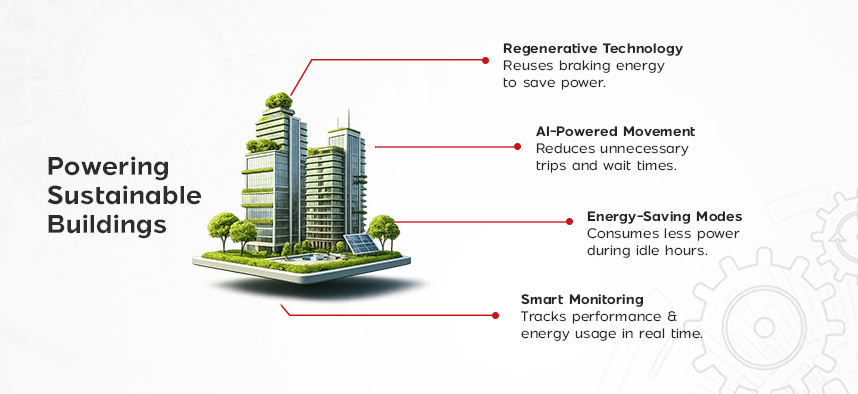
Sustainability is one of the primary objectives of smart cities. Buildings account for a substantial portion of urban energy consumption, making energy-efficient elevator systems a necessity.
Smart Elevators vs. Traditional Elevators
One of the biggest differences between conventional systems and smart elevator technology lies in intelligence and automation.
| Feature | Traditional Elevators | Smart Elevators |
|---|---|---|
| Traffic Management | Basic operation | AI-powered optimization |
| Maintenance | Reactive | Predictive |
| Energy Efficiency | Moderate | High |
| Monitoring | Manual inspections | Real-time monitoring |
| User Experience | Standard | Personalized |
| Building Integration | Limited | Full integration |
| Downtime Risk | Higher | Significantly lower |
| Data Analytics | Not available | Advanced insights |
This comparison highlights why smart elevators are increasingly preferred in modern smart buildings.
Enhancing Passenger Experience Through AI and IoT
Reduced Waiting Times
One of the most significant benefits of AI-powered elevators is their ability to reduce waiting and travel times. Destination dispatch systems ask passengers to select their floor before entering the elevator. The system then assigns the most efficient elevator based on traffic patterns and passenger destinations.
Benefits include:
- Faster journeys.
- Reduced crowding.
- Better traffic flow.
- Improved user satisfaction.
Touchless Elevator Technology
As buildings become smarter, demand for contactless experiences continues to grow.
Modern smart elevators can support:
- Mobile app controls.
- QR code access.
- Voice commands.
- Facial recognition systems.
- Gesture-based controls.
Touchless elevator technology enhances convenience while improving hygiene and accessibility.
Is your building ready for the future of intelligent mobility?
Talk to Our ExpertsImproving Safety and Security in Smart Buildings
Safety is a non-negotiable requirement in modern urban infrastructure.
Smart elevators contribute through:
1. Real-Time Monitoring
Building operators receive instant alerts regarding abnormal performance or system issues.
2. Emergency Response Integration
During emergencies, elevators can automatically follow predefined evacuation and safety protocols.
3. Advanced Access Control
Smart elevators can integrate with:
- RFID cards
- Mobile credentials
- Biometric systems
- Facial recognition technologies
This allows secure access to specific floors and restricted areas.
Smart cities are evolving fast. Will your building keep pace?
Upgrade to Smart ElevatorsHow Smart Elevators Are Transforming Indian Smart Cities
Several rapidly developing Indian cities are embracing intelligent infrastructure solutions.
Bengaluru
As India's technology hub, Bengaluru is seeing increased adoption of IoT-enabled elevators in commercial and mixed-use developments.
Hyderabad
With its growing IT corridor and high-rise projects, Hyderabad is investing heavily in smart building technologies.
Mumbai
Limited land availability has driven vertical development, making smart elevators essential for efficient mobility.
Pune
Modern commercial campuses and residential communities are increasingly implementing AI-powered elevator systems.
Ahmedabad and GIFT City
Emerging business districts are incorporating intelligent vertical transportation solutions into next-generation developments.
These cities demonstrate how smart elevators are supporting India's broader smart city vision.
Emerging Trends in Smart Elevator Technology
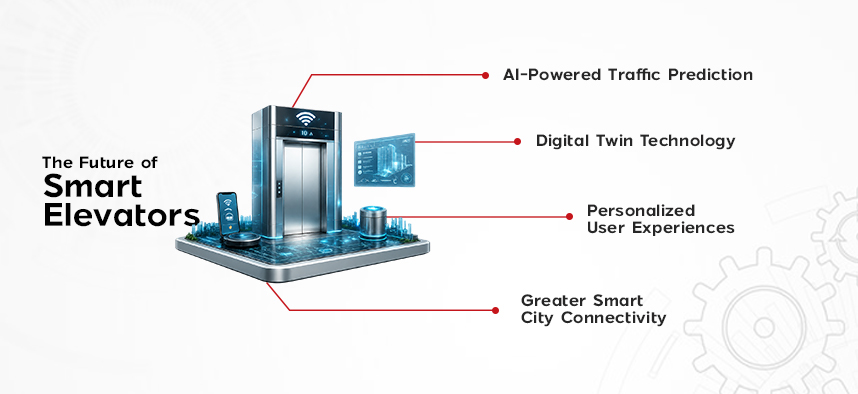
The future of smart elevator technology in India is evolving rapidly.
Why Smart Elevators Will Shape the Future of India's Smart Cities
As India's cities continue to expand upward, the need for intelligent vertical transportation will only increase.
Smart elevators address multiple urban challenges by:
- Improving mobility within high-rise buildings.
- Reducing energy consumption.
- Enhancing passenger safety.
- Supporting sustainability goals.
- Enabling predictive maintenance.
- Integrating with smart building systems.
- Improving accessibility for all users.
Simply put, smart elevators are no longer a luxury; they are becoming a necessity for future-ready cities.
How much efficiency could your building gain with a smarter elevator system?
Get a Free ConsultationFrequently Asked Questions
1. What is a smart elevator?
A smart elevator is an advanced elevator system that uses AI, IoT, cloud connectivity, and predictive maintenance technologies to improve efficiency, safety, and passenger experience.
2. How do smart elevators support smart cities?
Smart elevators improve urban mobility, reduce energy consumption, enhance building efficiency, and integrate seamlessly with smart building infrastructure.
3. Are smart elevators energy efficient?
Yes. Smart elevators use regenerative drives, intelligent traffic management, and standby modes to reduce electricity consumption significantly.
4. Can smart elevators reduce maintenance costs?
Yes. Through predictive maintenance and real-time monitoring, smart elevators identify issues early, helping reduce repair costs and minimize downtime.
5. Are smart elevators suitable for residential buildings?
Absolutely. Modern residential developments increasingly use smart elevators to enhance convenience, safety, accessibility, and energy efficiency.
Conclusion
The future of India's smart cities depends on intelligent infrastructure that improves efficiency, sustainability, and quality of life. Epic's smart elevators are playing a crucial role in this transformation by delivering faster, safer, and more energy-efficient vertical transportation. With AI, IoT, predictive maintenance, and seamless smart building integration, smart elevators are helping create connected urban ecosystems that support sustainable growth and modern living.
As India's skyline continues to rise, smart elevators will remain at the heart of the country's smart city revolution, enabling buildings and cities to become smarter, safer, and more efficient than ever before.

