

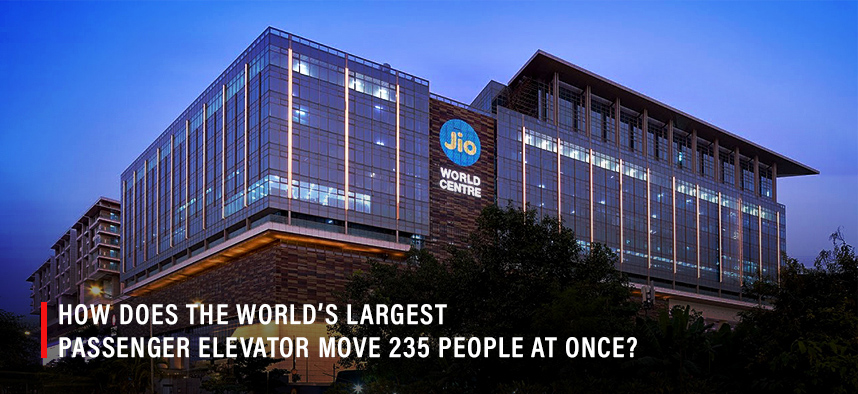
How Does the World's Largest Passenger Elevator Move 235 People at Once?
Imagine hundreds of people arriving at a convention centre simultaneously. Moving them between floors without creating long queues requires more than a spacious cabin. It demands careful planning, specialised mechanical systems, and a design built around passenger movement. This is where elevator companies in India play an important role in developing solutions for buildings with demanding transportation requirements.
At Mumbai's Jio World Centre, KONE has demonstrated what specialised elevator engineering can achieve. Its record-breaking passenger elevator was announced in May 2022 and designed to carry up to 235 people in a single journey.
But how does an elevator of this size actually work? How do its ropes, pulleys, hoisting machine, and supporting structure work together to move such a large load? And what can this installation teach us about the engineering behind modern elevators?
Let's explore the technology, design decisions, and safety considerations that make this remarkable installation possible.
Table of Contents
- Inside the World's Largest Passenger Elevator at Jio World Centre
- How Does the World's Largest Passenger Elevator Carry 235 People?
- What Makes a High-Capacity Elevator Safe?
- Why Passenger Flow Matters as Much as Elevator Capacity
- What This Case Study Reveals About Elevator Engineering in India
- What Should You Look for When Choosing an Elevator Company?
- How EPIC Elevators Approaches Application-Specific Vertical Mobility
- FAQs
- Conclusion
Inside the World's Largest Passenger Elevator at Jio World Centre
Located in Mumbai's Bandra Kurla Complex (BKC), Jio World Centre is a major destination for business meetings, exhibitions, conferences, and cultural events. Its large visitor volumes create a need for carefully planned movement throughout the complex. The passenger elevator developed by KONE was designed specifically for this environment, combining a large cabin with a specialised mechanical arrangement.
Here are the key specifications published by KONE:
- Passenger capacity: Up to 235 people
- Cabin floor area: 25.78 square metres
- Reported elevator weight: 16 tonnes
- Number of stops: Five
- Suspension arrangement: Nine ropes and 18 pulleys
- Hoisting machine: KONE EcoDisk MX100 heavy-duty machine
The cabin also features glass walls, a four-panel centre-opening door, information screens and decorative lighting inspired by the architectural theme of Jio World Centre. These features combine functional requirements with the building's visual identity. However, the most significant achievement lies beneath the cabin's design: the engineering required to support and move it safely.
The World's Largest Elevator Solved One Challenge. What's Yours?
Find Your Elevator SolutionHow Does the World's Largest Passenger Elevator Carry 235 People?
Moving such a large number of passengers requires several systems to operate together. The cabin provides the necessary space, but the suspension arrangement, hoisting equipment, structural support, and control systems make the movement possible.
Let's examine the main engineering elements.
1. A Cabin Designed for Exceptional Capacity
The first challenge is accommodating passengers without compromising the elevator's intended operating limits. With a floor area of 25.78 square metres, the Jio World Centre elevator provides considerably more space than a conventional passenger cabin. This allows it to accommodate a large group in a single journey, making it suitable for an environment where visitors may need to move between event spaces and other facilities. However, passenger capacity is not determined by floor area alone. Engineers must consider the rated load, passenger distribution, structural requirements, accessibility, and the available space within the building. A larger cabin also influences other design decisions. Its dimensions affect the supporting structure, suspension arrangement, door configuration, and equipment required to move it.
The key takeaway: Increasing cabin size is only one part of high-capacity elevator design. The complete system must be engineered to support the intended load and operating conditions.
2. Nine Ropes and 18 Pulleys Working Together
One of the most distinctive features of the Jio World Centre installation is its suspension arrangement, which uses nine ropes and 18 pulleys. To understand its importance, consider how a conventional traction elevator works. A hoisting machine drives a system that moves the elevator car through the building using suspension components and associated mechanical equipment. In a high-capacity installation, these components must be selected and configured to accommodate the forces generated by the loaded cabin. The arrangement must work with the supporting structure and hoisting equipment as part of a coordinated engineering solution.
KONE's published project information describes an innovative pulley-beam arrangement, with the structural shaft moving along rails fixed over steel columns. This illustrates why a specialised elevator cannot simply be designed by enlarging an ordinary cabin. Its mechanical and structural components must be planned around the demands of the complete installation.
3. A Heavy-Duty Hoisting Machine
The hoisting machine provides the mechanical drive required to move the elevator. For a cabin designed to carry a substantial load, the equipment must be appropriate for the system's operating requirements.
KONE identifies its EcoDisk MX100 heavy-duty machine as part of the Jio World Centre installation. The selection and integration of a hoisting machine involve several considerations, including the elevator's rated load, travel distance, operating frequency, and required movement characteristics. The objective is not merely to move a heavy cabin. The system must also support controlled acceleration, deceleration, and stopping within its specified operating parameters.
For elevator manufacturers, this highlights an important engineering principle: cabin dimensions, suspension components, and drive equipment must be designed to work together rather than treated as independent parts.
4. Structural Support and Controlled Movement
A high-capacity elevator places substantial demands on its supporting structure. The shaft arrangement, rails, steel columns and associated components must be suitable for the forces and operating conditions involved. The design must also account for the elevator's movement throughout its travel path. Its components need to remain aligned and operate within their intended limits. This becomes particularly important in specialised installations where the cabin and mechanical configuration differ significantly from standard designs.
The Jio World Centre project demonstrates how structural engineering and mechanical design must be coordinated from the beginning of a project rather than addressed separately after the cabin has been specified.
What Makes a High-Capacity Elevator Safe?
Moving more passengers in a single journey increases the importance of getting the complete system right. Safety cannot depend on one component or one feature; it must be considered throughout design, installation, testing, and maintenance.
The main areas of consideration include:
- Load management: The elevator must operate within its approved rated load. A stated passenger capacity does not permit the system to exceed its load limits.
- Suspension and structural integrity: Ropes, pulleys, supporting structures, and associated components must be appropriate for the loads and conditions for which they are designed.
- Drive and control systems: The system must support controlled movement, appropriate stopping, and reliable operation within its specifications.
- Door operation: Door systems must be designed to support safe passenger entry and exit, with appropriate protective features.
- Emergency provisions: Emergency communication, rescue arrangements, and other protective measures must comply with the applicable requirements for the installation.
- Inspection and maintenance: Regular inspection and preventive maintenance help identify wear, deterioration, and developing faults that could affect reliability.
For lift manufacturers, these considerations reinforce the need to approach elevator engineering as a complete system. A large cabin cannot deliver reliable performance if its supporting components, controls, or maintenance arrangements are inadequate. The specific safety configuration of any installation should be confirmed through its technical documentation rather than assumed from its passenger capacity.
If 235 People Can Move Together, Imagine What's Possible
Explore What FitsWhy Passenger Flow Matters as Much as Elevator Capacity
An elevator's capacity tells us how many passengers it is designed to carry in a journey. It does not, by itself, tell us how efficiently an entire building can move people. KONE reports that the Jio World Centre elevator serves five stops and travels at approximately one metre per second. Its configuration reflects a specialised application rather than the high-speed, multi-floor requirements associated with many skyscrapers. This distinction matters because different buildings have different passenger movement patterns.
A convention centre may experience a surge of visitors before a conference begins or when an event ends. A commercial office building may experience predictable morning and evening peaks. A hospital may need to prioritise the movement of patients, staff and equipment. These differences influence elevator planning.
Engineers and building planners consider:
- Expected passenger volumes during peak periods.
- The number of floors and the distances between them.
- Passenger waiting and journey times.
- Door-opening and passenger transfer times.
- The number of elevators required to serve the building.
- How elevators work alongside staircases, escalators, and other circulation routes.
This is why high-capacity elevator projects require people-flow analysis in addition to mechanical design. The aim is to develop a system that suits the building's actual usage patterns.
What This Case Study Reveals About Elevator Engineering in India
The Jio World Centre installation provides valuable insights into the capabilities needed for specialised elevator projects. It also highlights why elevator manufacturers in India must consider more than a product's standard specifications when addressing different building requirements.
Customisation starts with the building
A convention centre, residential tower, hospital, and industrial facility do not have identical transportation needs. Their elevator requirements depend on expected passenger demand, available space, building layout, accessibility, and operating conditions. The design process should begin with these factors before a suitable elevator configuration is selected.
Engineering requires coordinated planning
Cabin dimensions, suspension arrangements, hoisting equipment, structural support, and controls must function as an integrated system. The more specialised the application, the more important it becomes to coordinate the engineering, installation and commissioning processes.
Safety and reliability extend beyond installation
An elevator is a long-term building system. Appropriate component selection, installation quality, testing and planned maintenance all contribute to its performance throughout its service life.
Technology must solve a real problem
Digital monitoring, energy-management features, and other technologies can support elevator operation and maintenance where they are suitable for the application. Their value depends on how effectively they address the building's requirements rather than simply how many features a product offers.
For elevator manufacturing companies in India, these principles are relevant to projects of different scales. Whether an installation serves a private residence or a major commercial complex, the solution must be designed around its intended use.
What Should You Look for When Choosing an Elevator Company?
The world's largest passenger elevator is an extraordinary engineering achievement, but most buildings require solutions tailored to more specific needs. When evaluating elevator companies in India, it is worth looking beyond cabin appearance, advertised capacity, or individual technology features.
Consider these factors before making a decision.
1. Experience with your building type
Look for a company that understands the requirements of your particular application, whether residential, commercial, healthcare, or industrial.
2. Technical consultation and design
The company should be able to assess available space, expected passenger demand, and installation constraints before recommending a configuration.
3. Safety and regulatory compliance
Ask about applicable standards, safety provisions, testing procedures, and commissioning requirements for the proposed elevator.
4. Energy efficiency and operating requirements
Consider the elevator's expected usage, drive technology, energy consumption, and potential long-term operating costs.
5. Installation and maintenance support
Reliable installation, scheduled maintenance, service availability, and access to replacement components are important considerations for a long-term investment.
6. Customisation options
Depending on the building, cabin finishes, door configurations, accessibility requirements, space constraints, and control options may influence the final selection.
Comparing lift manufacturers on these criteria can help building owners understand how well each proposed solution addresses their practical requirements. The objective is to select an elevator that suits the building, rather than choosing a system based on one impressive specification.
The Right Elevator Decision Starts Before Installation
Plan Your Elevator ProjectHow EPIC Elevators Approaches Application-Specific Vertical Mobility
The engineering principles demonstrated at Jio World Centre also explain why elevator selection should begin with understanding the building and its users. EPIC Elevators offers solutions for different applications, including passenger, bungalow, hospital, scenic, and goods elevators. Its product range addresses varying requirements for residential, commercial, and specialised environments.
For example, a residential property may prioritise space efficiency and cabin aesthetics. A hospital needs an elevator suitable for its patient and equipment movement requirements. A commercial building may place greater emphasis on passenger flow, operating frequency and service support. These different needs call for different technical considerations.
Rather than assuming that one configuration suits every building, the selection process should take into account the intended application, available space, expected usage and relevant safety requirements. For buyers comparing elevator manufacturers, this is an important distinction: the right product is the one that addresses the project's requirements and can be supported throughout its service life. EPIC's range provides a starting point for exploring elevator solutions suited to different types of buildings.
Frequently Asked Questions
1. How do elevator companies in India design high-capacity elevators?
The process begins with understanding the building's passenger demand, available space, travel distance, and intended use. Engineers then evaluate cabin dimensions, rated load, suspension arrangements, drive equipment, structural support, and applicable safety requirements to develop a suitable system.
2. What should you consider when comparing elevator companies in India?
Consider the company's experience with your building type, technical consultation, product range, safety compliance, installation quality, energy efficiency, and after-sales support. The proposed solution should match your requirements rather than rely on general claims about capacity or performance.
3. What role do lift manufacturers play in high-capacity elevator engineering?
Lift manufacturers are responsible for developing solutions that integrate the cabin, mechanical components, drive systems, and controls according to the intended application. Depending on the project and their scope of work, they may also provide installation, commissioning, and maintenance services.
4. How do elevator manufacturers ensure passenger safety?
Safety depends on appropriate system design, compliant components, load limits, protective devices, testing, correct installation, and regular maintenance. The specific provisions required depend on the elevator type, installation, and applicable regulations.
5. How many people can the world's largest passenger elevator carry?
KONE announced its passenger elevator at Mumbai's Jio World Centre with a capacity of up to 235 people. The installation has a reported cabin floor area of 25.78 square metres and uses nine ropes and 18 pulleys.
Conclusion
Moving up to 235 people in a single elevator journey requires much more than a spacious cabin. The installation at Mumbai's Jio World Centre brings together a specialised suspension arrangement, a heavy-duty hoisting machine, structural support and building-specific planning to address the demands of high-volume passenger movement. The broader lesson is that successful elevator engineering depends on coordinating capacity, mechanical performance, safety and operational requirements.
For elevator companies in India, these principles are relevant across residential, commercial and specialised projects. Every building presents a different challenge, and the right solution begins with understanding those requirements. Whether you are planning a new installation or evaluating options for an existing property, choose an elevator based on its suitability, safety, reliability, and long-term support.

